Pages

Tuesday, 28 August 2012

Connecting With Yellow In Nature


Yellow is Hope and Happiness

Connecting with nature is something that we are falling in love with since few months now. Today, we chose to go on a nature walk to be friends with anything yellow in nature.

We picked a tiny yellow flower that captured our eyes.


We observed and discussed about leaves that had turned yellow. 


The sight where a stem of a baby bamboo tree that had turned yellow while other stems remained green was very captivating.


Then, we moved on friending something really yellow. We distinguished buds and fully blossomed flowers. We were also able to distinguish the buds that might bloom tomorrow and the other tiny buds that may not bloom tomorrow.


We were overawed to observe one more yellow friend who was fully bloomed and enjoyed a similar flower with some of the petals bloomed while others remained babies as yet.


We didn't skip the leaf that had yellow lines running across it.


We returned back home, enjoyed the evening breeze in our balcony, to capture one more yellow before we said farewell to the yellow in nature, only just for today. 


We know that our journey of connecting with nature will continue with more inspiring colours. If you are new to nature walking, this could be a first step for you. Taking a colour nature walk with your kids and family is the easiest, simplest and an inspiring one. Look for colours in general or a particular colour in nature and explore, connect and be blessed.

Enjoy Learning and Sharing

Sunday, 26 August 2012

Whose Learning Is It Anyway?


A teacher in an International Indian school pointed out to the alphabet 'A' to S who was just over 3 years old and said, "Come on now say A apple". S replied, "A air plane". The teacher said, "No honey, A apple". S keenly gazed at her and said, 'A air plane". The teacher was at the end of the rope. She continued, "Sweet heart, say A A A as in apple". Then, she showed another flash card that had an apple picture in it and tried one more time, "Apple"; now with a bit irritated face. S nodded 'NO', made hand gestures of an air plane flying up in the sky and said 'Zoooom, A air plane". The teacher turned back and looked at me and said, "He is not listening".

Another day, S brought back home a worksheet that he needed to complete. The exercise was to match similar shaped fish in two columns. While I was beside him, I noticed that he looked at the worksheet and suddenly became so very sad. I didn't quiet understand when he started to cry querulously. The next thing he did was to pick a blue coloured crayon and he vigorously coloured the whole background. When he was done, he said, "No water and fish die, now no, they can't die. I put them in water". His eyes twinkled with joy because in his world, he saved the fishes by putting them back in water. He knew that is exactly how fishes could survive life; in water. The moment of realization that my sweet heart was aware of a huge fact about the life and death of a fish, was nothing but a jubilant moment for me. 

The next day I went to the school to pick him up when his teacher stopped by to chat with me. She said, "S has coloured the whole paper with blue. The exercise was just matching the same shaped fishes.". I smiled and exclaimed with sparkles in my eyes, 'He realized that fishes can not live without water and he coloured the whole background blue." The teacher replied in a stern voice, "He needs to follow instructions. He can't do his own things". I was shocked to hear this. I immediately felt that the teacher was not acknowledging what the child wanted to learn naturally. I felt that the child's autonomy was not respected and he was not given the freedom to express what he learnt. Later in his school days, this became a pattern. He was forced to learn and perceive things only according to the instructions provided by the teacher and worksheets. Creativity, critical thinking, freedom to express and think differently, self esteem, independence... the list goes on - everything went in the soup. 

My boy is now 8 years old. We recently visited Kabini, a popular wild life destinations and a river resort area in Karnataka, India. I was overawed when I saw the lush green fields, the humongous banyan trees, widespread sugar cane, turmeric, okra, ragi (finger millet), baby corn and cotton fields in and around Kabini. It was a treat for my eyes. My excitement bubbled up, beamed into my child and I really wanted him to enjoy the same treat. We stopped our vehicle to take a closer look at the fields. S enjoyed all the beauty and said, "Amma, it is so beautiful". Throughout the trip, I insisted my boy to watch the fields and intentionally showed him the plantations so that he could learn how and where crops are grown. I realized that he wasn't much interested in watching the fields.

Later, when we went for a walk near the lake around the resort, S was so fascinated by the 'touch me not' plants and started to play with it. There were plenty of them. We stopped by a place where some men were constructing a building. S wanted to stop and watch the men who were building a brick wall. He keenly observed how they were building a brick wall. Few months back, he wanted to understand - "How people build a brick wall?". He had even watched a You Tube video on that. Now, when he was able to really see some men being in action, he was excited to watch it. There was a huge heap of black stones near by. The stones were so beautiful and shiny. S wanted to pick one and keep it to himself. Three days passed by in a serene way, added fun and play for our little boy. S spent his time walking and marching on the sides of the lake and jumping in the trampoline. S also brought back, a stick of a tree branch that he was playing with. 


Back home, we rested for a day and he started to write about his trip. He needed my help to ask him open ended questions so that he could generate a content. He wrote all about how he played with the 'touch me not' plants, the tree twigs and how he jumped in a trampoline, his experience of visiting the elephant camp and more. He also mentioned that he brought back home a black stone and a stick from a tree branch. But, never he mentioned about the sugar cane, the finger millet and the cotton fields. I wondered how much I insisted that he connect with the lush green fields, but he still could not remember anything about the fields and the plantations. All he could remember while writing were the 'touch me not' plants, the tree stick, the  black stone, the trampoline fun and how he enjoyed walking along the sides of the lake. 

My point is - children learn what they see and live in a way that is pertinent to them. They are very present and conscious about how they perceive the resources around them. They construct knowledge and ideas related to what they are interested about.  They learn something because they are interested in that and not because we ask them to learn. And, they take sincere responsibility for their learning. When an educator allows a child to express what they learn and perceive in a way they see it, children feels acknowledged and their curiosity to learn more deeply, increases. 

A child sees an air plane in an 'A' while a teacher sees an apple. A child can feel that a fish can't survive without water and he pours out compassion with the help of a blue crayon to save those fishes. I look at the lush green fields while he is interested in the black stone, the twig and 'touch me not' plants. The child is perceiving his environment intently, learning what he wants to learn in a consistent manner. But we think, they are not listening to us or not learning what we want them to learn. 

As educators and learning partners of our children, let us stop, pause and ask ourselves this one powerful question, "How many times do we see through the eyes of a child?" There is a world out there with overflowing opportunities where our children learn continuously without any break. And they learn much more than what we want them to learn. Yes, they do learn. All the time. And, they sometimes seek beyond the limits that we set for them. It is only we don't see it. 

And when we see through their eyes, we will surely be able to acknowledge that there is abundance of learning happening in their world. And watch out, it may be more than what we think their capacities are. They may not be interested in learning about the shape of a fish, they may be learning much more than a mere shape - about the very life of a fish. 

Enjoy Learning and Sharing

Wednesday, 22 August 2012

Sky Watching - Amazing Fire Rainbow

The land near our apartments is an empty one and it is our window to enjoy the nature, the greens and the blues which will probably be lost once another builder will occupy the land in few years. It has been our  (mine and our son's) usual activity nowadays to take some time, stand in our balcony and enjoy sky watching. Few days back, to our surprise we could see something like a rainbow in the sky. 


When we observed more keenly, we were sure that it wasn't a rainbow. S said in a quiet tone, "Amma, it seems like the fire rainbow that we read about". I remembered having seen a fire rainbow picture and information related to it in National Geographic few months back. Fire Rainbow, the flame like appearance is actually called as the circumhorizontal arc which is an ice halo formed by plate shaped ice crystals in high level cirrus clouds.


I was sure the one that we saw was a fire rainbow. It was amazing to watch such a thing in the sky. I read that fire rainbow is the rarest of all naturally occurring atmospheric wonder. At that moment, I really felt blessed. 

Fire Rainbow captured in Navalur, South Chennai, India

Charlotte Mason says 

"Nature knowledge is the most important for young children. It would be well if we all persons in authority, parents and all who act for parents, could make up our minds that there is no sort of knowledge to be got in these early years so valuable to children as that which they get for themselves of the world they live in. Let them once get in touch with nature and a habit is formed which will be a source of delight through life. We were all meant to be naturalists..." (Vol 1, II Out of Door Life For the Children, p. 61)

Connecting with nature and seeking to learn more about it; has been something that we are busy with, in the recent few months.  Connection with nature has been slipping away from children in this generation.  It is been said that children grow healthier, wiser, more content when they are connected with nature. As a first step to provide my child an experience of the world that he lives in, I started to enjoy the nature myself. I am forming a habit to look in for simple natural things that is around me. I wish to have simple interactions  with nature that is available around me, include and encourage my son to participate in those moments. 


Sky watching can be an effective activity for sensory stimulation. I believe majority of our learning happens through 'Seeing'. Nowadays, I am inspired to create this bond with nature, because the moments when I become one with nature provides me a sense of healing in a sometimes hostile and frightening world. For a young learner, sky watching could be an activity that involves sensory stimulation, but in my case, it is also very holistic since it involves my emotions that requires stimulation to learn to heal myself. 


Needless to say that I have been experiencing these healing powers of incredible nature after I have started to learn with my son. I wish we could create such stimulating learning spaces and opportunities for ourselves that strengthens our connection with nature, make nature education as a part of our daily lives and embrace the wisdom inherent in nature.

Enjoy learning and Sharing. 

Saturday, 11 August 2012

Measuring Can Be Fun too

Children love to learn and they are very creative enough to transform their play into a learning experience. Learning need not be confined to worksheets and abstract concepts. When left alone, they could even come up with their own creative idea and invent their own learning method. The only thing that I learnt that I need as an educator is to keep restrain. I had to be patient enough to let ideas blossom naturally by giving time, space, freedom and by providing a loving and non interfering environment for him to unleash his creativity. S loves to play with Jenga blocks. You could believe what I am saying by looking at the pictures. 


One fine day, after playing with the blocks for some time, he was able to figure out that the Jenga blocks could be used as a tool to measure things at home. He measured as many objects as he could using the Jenga blocks and prepared a report that gave details about the length of each object that he measured. It was amazing to read the report he prepared in a quick manner that read "My noddy car is 2 Jenga blocks long. My favourite book is 3 Jenga blocks long. Our centre table is 11 Jenga blocks long..." I noticed that he generally writes slowly but the time he took to prepare this report was too very fast and I could not believe the speed with which he did that.


That leaves me with - Children can develop their own lesson plans. Knowledge and concepts amassed through such self directed learning is huge and lasts for ever because it is actually original. And that is so much fun for them too.

Enjoy learning and sharing.


Sunday, 11 March 2012

Handling Emotional Needs for Learners

Few days back, I was watching some little swimmers acting submarines with their swimming skills in our community swimming pool. It was a wonderful sight to watch them all. When the children were done with their swimming, I had this strange curiosity to approach a bunch of boys and ask them why they were learning to swim. I asked couple of boys and got an immediate reply from one, "My mom wants me to learn swimming". Another replied, "I like to swim in water". Another replied, "I want to become an expert and be a famous swimmer, win lots of medals". I came back home and asked my son, "Why do you want to learn swimming?" The answer came in a lightening speed - "I want to be brave". I was stuck with awe after hearing this authentic, innocent answer which he gave in an effortless manner.  I said, "So, swimming is about being brave for you!!!". He added after a moment, "Yes, swimming is an expression of my bravery".


The whole experience was full of rich lessons for me. Here are some of them that I'd like to share with educators and parents. With parents, schools and educators focusing on academic achievement more and more, recognizing learner's core desire to fulfill their emotional needs is ignored. Emotional achievement is a forgotten area that I'd like to throw light at.

In my son's case, it is not a surprise for me when he expressed his emotional need and its relationship to swimming. The only thing that I was bowled over was his ability to express this to me clearly. I have been observing since many months, in fact almost a year now; that his drive to learn just about anything originated from wanting to nurture his bravery. For example, he was inspired by a boy whose name is 'Veer' and wondered why he was not named as 'Veer'. 'Veer' in Indian language means 'Warrior'. He was always so fond of drawing the Chinese symbol that represented 'Bravery'. That triggered him to learn more about Chinese symbols. He had been learning a lot about warriors from different parts of the world. He was always perfecting his 'Warrior Pose' (Veerasana) in Yoga. The learning opportunities and the content that he chose was to braving himself. His every chosen learning activity was something that would actually make him a bit more valorous. I have been intently observing and journal ling all his behaviors for almost a year now, so that I am able to support him in his learning journey in a way that is relevant and pertinent to him.

I started to wonder that the child who expressed that he wanted to get medals may also have some innate emotional need beneath the desire to achieve. Emotional needs can be a major pre-cursor for achievement in academics and other competitive areas. Educators and parents have always looked at intelligence as one dimensional trait, accessible to evaluation by numbers. On the flip side, creating emotionally sound learning environment and opportunities help learners to improve academic outcomes.   As parents and educators, our job is to tap into this emotional need that is craving to be expressed in every learner and support them to handle such feelings at first place. Unleashing this internal desire of learners can lead educators to bring out the learner's best externally. A point to note here is that our job is to plan differentiated instruction as per the learner's requirement. A child who wants to swim for joy should be given opportunities to enjoy a calm learning experience. A child whose focus is to collect a couple of medals will be willing for more challenges and hard work outs. The child who wants to brave should not be put to shame and the facilitator might want to take careful steps to nurture that value for him. This is not only pertinent to young learners. I was surprised that even adult learners in a Corporate training program that I recently delivered, came up with a lot of emotional needs that needed to be addressed during when I was conducting needs analysis.

Abraham Maslows suggests in his theory that the following needs of a child should be first met before any child could learn.
  • Physiological needs: nutrition, sleep, exercise, health
  • Safety needs: both physical and emotional
  • Love and belonging needs: affection shown to the child, trust of those around him, someone who listens, daily order, a right to privacy, unconditional love
  • Self-esteem needs: someone affirms the child's worth, child is given the opportunity to achieve, to make choices, to be successful, respect of others, respect by others
  • Self-actualization needs: child is developing abilities and strengths, problem-solving skills strengthening, creativity, morality, spontaneity, lack of prejudice, acceptance of facts
Emotional learning and skills related to that such as recognizing and managing one's own emotions can be the best predictors of both academic and life success. What steps can we take to help children to make them understand the nature of biology, emotions and intelligence and their relationship with success as well as happiness? How could you offer differentiated instruction as per the learner's emotional needs?

Enjoy learning and sharing

Tuesday, 21 February 2012

Musings on Doing, Being and Living Consciously

Lately, I have been very lethargic. May be because I am just unwinding and de-stressing after a long awaited event that happened in our family. While I say that "I am destressing", I notice that I am not doing anything to de-stress; the body has naturally been doing the unwinding job by being so lethargic and making me sleep more than I usually do. Believe me or not, sleeping is one of the difficult tasks for me on earth. I am so surprised how I am sleeping so much nowadays. It could be that my body naturally needs that much rest. Anyways, I am letting it be and allowing what so ever is happening.

Sometimes, we tend to forget that we really are tired and when we sit down to relax, we notice that the body automatically wanting to unwind. I notice this in moms and more in working moms or working from home moms. If we are not conscious, we are never aware how much stress our body goes through. Rest is so important for mothers (whether working outside home or not). I have generally noticed that mothers have this pattern of over committing. I am not talking about the habit of over committing to others. I am talking about over committing to oneself. The impact of such over commitment is generally not noticed and life moves on.

Recently, my husband shared a thought provoking quote with me.  He said the quote is from some movie that he does not remember and the quote goes like this, "Your ego writes checks that your body can not cash" . I would rather add, it is not just ego, even when passion takes more room, that is when balance is out of place. The balance that I am talking about is wanting to always do more rather than simply just being and letting things take its course.

"Many of us are so tied up with the identity of what we are doing rather than focusing on who we are being. ‘Doing’ is focused more on achievements measured by external standards. ‘Doing’ is more directed and intentional. But what is allowing these external achievements with an authentic quality is the ‘being’. ‘Being’ immerses us in the flow of life. It is about allowing it to happen, letting go, and accepting what is there. ‘Being’ orientations values the person and not the achievement. It is inward, placing greatest emphasis on rewards that are intrinsically meaningful to the person." 
--------------- Coaching for Self Awareness - The role of coaching in helping you identify who we are (2009) by Prabha Sathyanarayanan (Ref: Co-Active Coaching: New Skills for Coaching People Toward Success in Work and, Life by Laura Whitworth)

So, we don't need to come up with a list of skill sets to manage oneself during burn outs or explore ideas to de-stress. Just being in the moment immerses us in the flow of life. It can relax us and not allow us to participate in the race that forces us to achieve or die. It is simple. This is what I got to say. The only thing we might choose to do in such situations when we notice that we are either getting unrealistic with our goals and thereby experiencing burn outs due to over commitment is

LIVE CONSCIOUSLY.

There is this book that I have come across. It is a book that was a part of the prescribed curriculum when I was getting trained in Co Active coaching at CTI, The Coaches Institute, California. The book is Taming your Gremlin by Richard D Carson. There are many things that I learnt from this book but one simple yet powerful thing that I learnt from this book is TO SIMPLY NOTICE. Simple two words, but believe me, they are really very powerful words.  The first step to live consciously is to simply notice. Simply noticing ourselves unleashes many insights on who we are being and what we are doing at the moment. It increases self awareness, thereby we start to think in an emotionally intelligent manner to find out whether what we are experiencing at the moment is valuable, meaningful and purposeful for us.

For learners, letting go of any kind of  attachment, simply being in the moment, enjoying the process, not stressed out to run a race and not wanting to reach somewhere ; all of these can be a very liberating moment. This kind of an experience can really make children develop a positive attitude towards learning rather than asking them to commit to finish writing with in 10 minutes and finish reading with in 16 minutes or asking them to solve 13 addition problems with in the next half hour. I see that many schools and parents are creating a competitive environment where in lot of pressure is being put on children forcing them to achieve with in limited time. Now, let us stop and ask ourselves this question - Are adults over committing on their behalf, setting unrealistic goals for THEM?  This is something to think about. While setting realistic goals are necessary, putting such pressure on children can kill creativity.

LEARNING BY BEING is equally important as LEARNING BY DOING. The need of the hour is BALANCE. Encouraging children to be conscious of who they are being, what they are learning, what is happening around them or with them, helping them to notice their emotions etc can help them to become joyful learners. I intentionally take this approach while I create a learning environment for DS.

So, let us take a moment to simply notice, live consciously and learn to BE in the moment. It is a wonderful medicine to all stress, burn out and over commitment that we get sucked into. And, let us not set unrealistic goals for our children either. I invite hands to join me to take a stand to let our children enjoy the process of just BEING. Let us all live a conscious, meaningful and purposeful life.

Enjoy learning and sharing.

Saturday, 12 November 2011

Integration of Art and Writing Skills

Tell me how many children throw a tantrum when you ask them to write the same alphabets again and again. Here is a way S integrated art and writing skills, created a fun experience for himself.

Few days back, we did some tape resist painting and S enjoyed it so much. I admired his poised attitude during the process. When I posted our tape resist painting, Mommy Labs connected with our activity and remembered how they enjoyed tape resist arts. They bonded again to come up with some beautiful tape resist paintings. S got inspired by one of their paintings that had intricate black colored designs. An idea that triggered in his mind after viewing those pictures is to doodle Kannada ( an Indian language) alphabets in the un-taped spaces. And here, he came up with an artful Kannada alphabets.


So, now we know that not only is art healing, colourful and fun, it also helps children integrate learning. Writing has not been that easy for him in his early years just as it is to any other child. Though he writes and reads English very well nowadays, any kind of alphabets writing when we try to explore other languages, reminds him of the difficult days he went through in his early years. 

He used to always be scared for being a slow writer. He even came up with an idea during this activity to address that. He started playing 'start-stop', a fun game that he invented. The game is to watch the time he took to complete each un-taped area. He loudly counted the number of seconds it took for him to write an alphabet in one un-taped area. This helped him develop a timing sense too and most important, he was giggling throughout the time. 

I realized that integration of learning with something that the children love to do will ease their fear and help them maximize their potentials with grace. 

Enjoy Learning and Sharing

Wednesday, 9 November 2011

Exploring 3D Shapes

Lately, we have been integrating Math and art a lot. In an attempt to explore 3 D shapes, my sweet heart ended up making many colourful models . And the joy doubles when we are able to accomplish such work with the very simple materials that we have at home. Being a dominant spatial learner, my boy thoroughly enjoyed this activity since comprehending 3 D images and shapes is very easy for him. 


While parents and educators are worried nowadays that children are starting to loose focus by the stimulation of high energy distractions from the surrounding environment, this is one such activity that can really slow down a child and take them to the meditative world. For my son, what kept him occupied and challenged was to get the structure of the car he made, to put the model upright without having it to fall. Though it was challenging for him, he looked very calm and focused. It was an opportunity for me to observe him and understand that he will not give up. 


What activities have you done that really was relaxing for you and at the same time helped you to integrate a key concept in learning?

Enjoy learning and sharing.

Art Influences Imagination

"Logic will get you from A to Z, imagination will get you everywhere" - Albert Einstein.

Can you teach a child to imagine? How can one be imaginative? Is it natural? Can I really unleash imagination in someone else? Well, sharing my experience about how a child can powerfully and beautifully unleash his imagination when an educator gets curious about their work. 
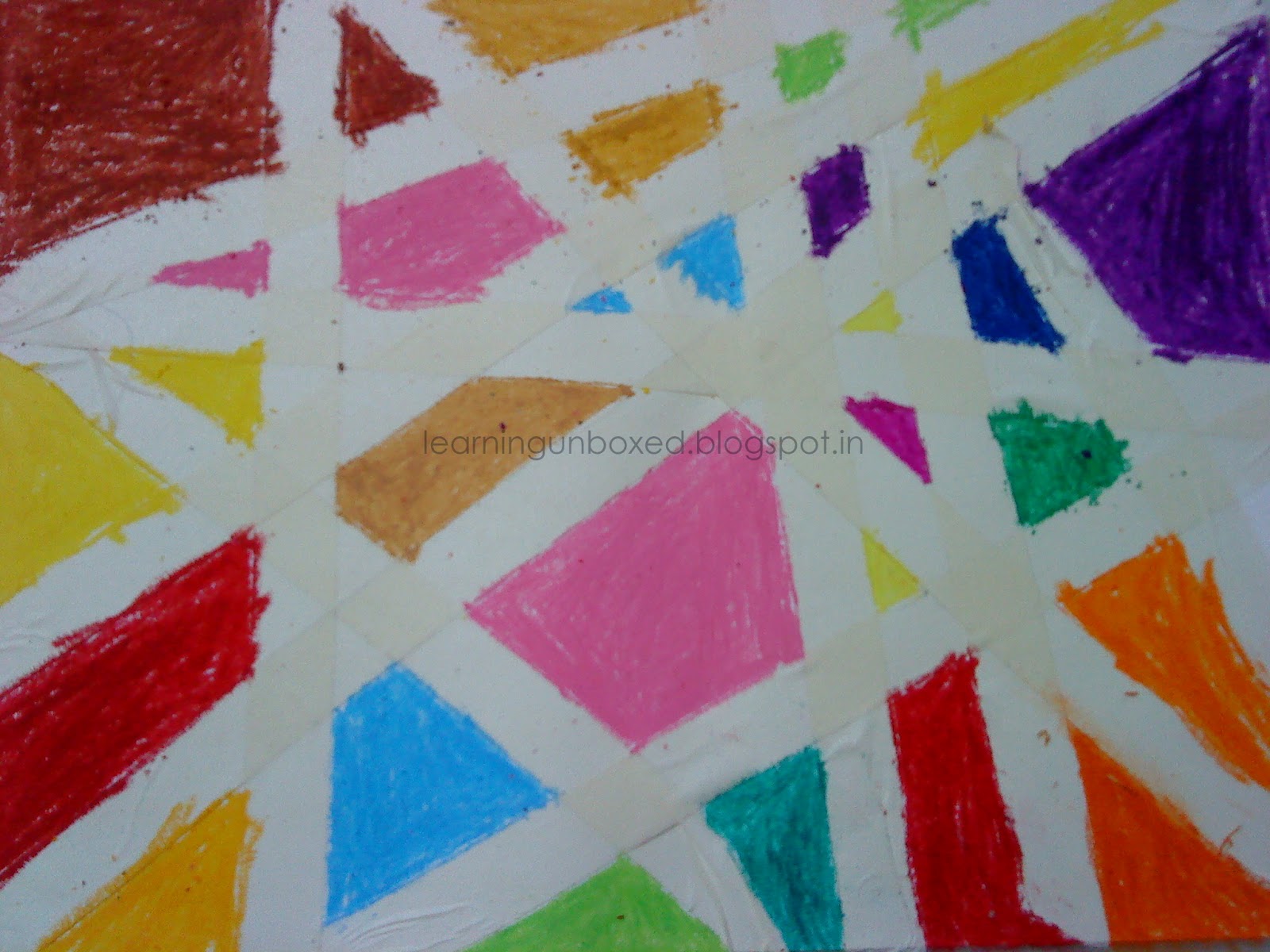
It all started with a tape resist art that we chose to do. An initial discussion about tape resist painting was good enough for him to be curious and jump in to work on it. With some help in holding the tapes initially, he was ready to start colouring and was on his own. Here is what we got.


Well, honestly, through my eyes it was a piece of art with tapes pasted and the gaps were colored. It looked beautiful and fantastic, the child liked to do it. But that was not actually where it ended through the eyes of my son. I have this habit of asking open ended questions while coaching or facilitating learning, mainly because I am a professional coach trained in Co Active coaching model. 

Here is the link if you would like to know more about Co Active coaching.


One of the cornerstones of Co Active coaching is that the client/learner is naturally creative, whole and resourceful and that they have the answers or they can find the answers. The job of a Co-Active Coach is to ask powerful questions, listen and empower to elicit the skills and creativity a client already possesses, rather than instruct or advise. Hence, asking open ended and powerful questions has always been a part of my facilitation style.

Once he finished his work, I just asked him couple questions related to what does the art mean to him and how does he visualize it.  The very next moment, he started to explain, "I will tell you. The green color and the baby pink color is the beautiful lotus flower in the middle. Near the lotus, you see a red rose garden. In between the lotus and red rose garden is the grassland. On the other side, you can see a big strawberry farm and below it is the soil area where there are no flowers. And the blue patch is the big west swimming pool . On the south east, is maple tree full of orange autumn leaves (he is very fond of maple leaves)." He went on to add that the blue patch on top of the lotus is the smaller swimming pool towards north, a rose garden in north west area, the yellow patch in north east is the park and the other two yellow patches are the western parks and the list went on and on. All I could do was just listen and visualize a beautiful farm, garden, swimming pools, mango groves etc through his guided imagery.

Such is the imagination of a child which is very vivid and beautiful. I was amazed by the creativity he demonstrated, firstly to visualize nature in few patches of oil pastel colors and secondly his mastery in the way he integrated Geography with this art to reinforce his knowledge about directions. If I had not asked the open ended question, I may not have come to know about his visualization. I was very happy to understand his creative imagination . 

One precious gift that we can give our children is to ask questions, listen to them keenly and lovingly, not impose our ideas unto them. This is nothing about teaching creativity, but it is very much about understanding how creative they naturally are.  Mainly, it is about being curious and being interested in them. In cases where children demonstrates vivid imaginative skills, it is expected that the educators accept unusual ideas and not be judgmental about their ideas. While a visually dominant child can demonstrate such strong visualization skills naturally, guided imagery has been proved to be a positive way of helping all children in general to visualize in order to encourage imagination. Either ways, the child actually imagines and 'Imagining" is a higher order thinking that helps anyone to communicate in a unique way, creatively think to form original and innovative ideas.

There are times when the educator gets creative and introduces own concepts and ideas to the learner, which could be a requirement too. Learning is a beautiful and connected dance between the teacher and the student in which  both take the role of the learners and dance in the moment.

Have you ever noticed that children keeps imagining about wonderful things? If not, it is time to observe them, start a conversation with them to allow them to guide us, so we can learn lots and lots from them about their dream world. 

Enjoy learning and sharing.
Prabha

Sunday, 25 September 2011

Understanding different Learning Styles

So, why should an educator even bother to understand different learning styles? Before I answer this question, I would like to share with you a little story.

Many say that children learn a lot through practical life activities. Practical life activities helps a child understand his/her environment and how it works. The child feels valued and the practical life activities increases the child's self esteem since the activity focuses on inclusiveness and sends them a message that they have an important role in the family. I involved my son in one such activity few days back. I asked my son to prepare a shopping list. I gave him a paper and pencil and asked him to write the heading "Things to buy" and I went in to my kitchen to continue my cooking. I started to tell one by one all the things that we needed to buy and I heard answers "yes, mommy.. I finished adding" for each item I was mentioning. After I was done with listing all the items, I told my son, "now, keep the list safely and let us get ready to go for shopping in  few minutes". My son shouted, "Wait, I need to color". I wondered, "What do you need to colour?". I went towards my son to find out what he has done with the shopping list. To my surprise , I saw a cart full of items represented as a beautiful picture. I could not believe someone would represent everything in pictures. And, he did that so fast and you may want to take a look at the shopping list below. The shopping list had beautiful representation of ghee(clarified butter), greens, salt, okra, apple juice, Kellogg chocos, wheat bran flour, lentils, bread and jam.


Knowledge and information need not be expressed only through words. There are some people who like to express through images and pictures. Sarah Major in her article 'Moving More to Center with Visual Learners' says, "Most children from ages 4 to 7 learn best through images since they're at the stage in which the right hemisphere (gestalt brain) is rapidly developing as a normal neurological function. Many children naturally are strongly visual in their learning style. According to the experts, this percentage of all children is pretty high."

She adds, "Children who have spent a great portion of their time immersed in media such as television, video games, computer games all develop a strong visual sense. Even if their neurological wiring would have been predominantly left-brained, their experiences in life create a strong right brain and make them visual learners. " which is very relevant to the children of 21st century who has more access to visual imageries around them in their environment nowadays.

So, coming back to our question, "Why do we have to understand different learning styles?". A simple answer could be this - it is no point to invest time and energy in instructional strategies that is not suitable for the learner. Only if the educator work with the learner's style, the probability of learner's understanding increases. I came across a video which actually can give the answer we are looking for. Take a look at this video.

Animal School

It is about having alternate methods to teaching and learning. It would be a boon for everyone if education system can be more flexible in providing alternate methods to teaching thereby being inclusive of all kinds of learners. All it means is that if my S chose to express the shopping list in visuals, that is who he is and he is intelligent in expressing that way. Forcing him to express through words is not an effective way to nurture his joy for learning, atleast in the beginning years. Though, it is possible to nurture whole brain development in children while they are growing.

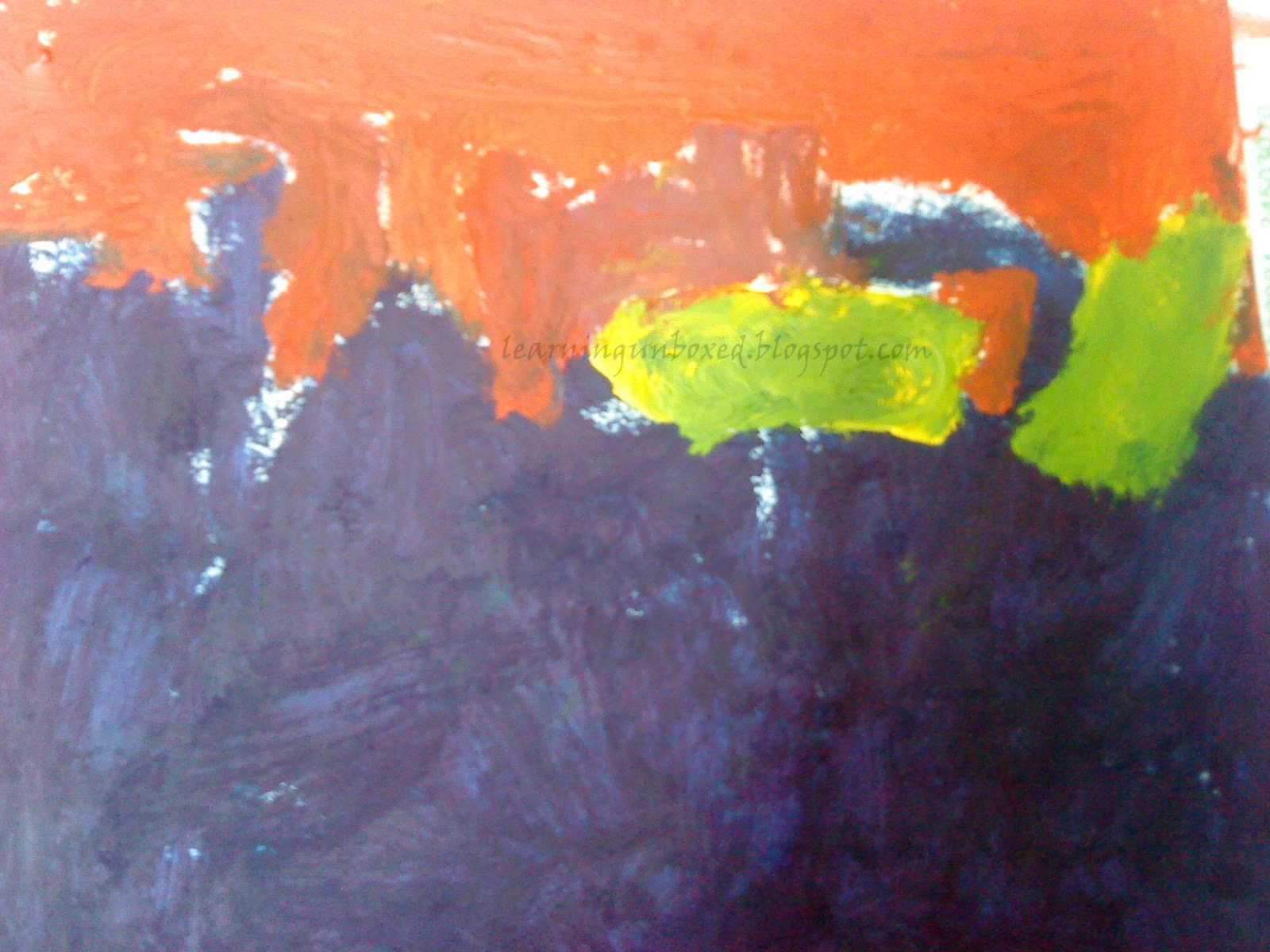
Educator need not be savvy in expressing in different ways. It is just enough if the child is allowed freedom to express knowledge the way he/she wants to. Another story from the learning journey with my son would clarify this. It was the first time S was going to do oil painting. He asked me, "So, how do I use this". I had no idea how to do oil painting. I am not an artist, but I am his facilitator in his learning process. So, I did a quick painting and showed it to him, "this is what I have done, you could paint whatever you want to paint". The only thing I assured him is that he is free to paint whatever he wants to, can use paints lavishly and that he need not worry about messing his shirt and the table. The table was well arranged to handle the mess. I went away and came back later to see this wonderful first oil painting that he did.


He said that it is a van in the dark moon light. There is so much depth in his painting and I was amazed. This is a seven year old's first oil painting. And you surely might want to take a look at the facilitator's (and that is me) painting.


I didn't feel that my painting had that much depth and as you can see, definitely his painting is better than mine. That shows that the educator need not be an expert in all areas. it is only about providing freedom and an environment where in they can be original and their expertise is nourished. 

Here are some of the other paintings done by DS with in few days since he made his first painting.


That was Oswald in the Blue Ocean. The following picture he says is Tsunami in Japan.


The green coloured things are cars and buses floating. When asked why he has used the red color, he said people dying in Tsunami reminds red colour for him.

S is very fond of gem stones, particularly diamonds. Here is an attempt to paint a diamond. 


What I learnt as an educator in our oil painting adventure is that I don't have to possess all kinds of skills similar to my learner. All I have to do is allow freedom for the child to express in a safe and peaceful environment in a way he/she wants to express. If I would have prepared a shopping list, it would have been expressed only through words. In order for educators to nurture children's creativity, it is very important to understand their learning styles. Simply being aware of learner's strengths and weaknesses to learning styles will allow creative learning.

Enjoy Learning.

MyFreeCopyright.com Registered & Protected